


Purpose: Explore culturally responsive schooling (CRS) through three interactive activities. These activities help you to think about some of the key elements of cultural responsiveness and familiarize you with the structure of the CRS rubrics.
Participants: Teachers, leaders, counselors, and relevant school community members.
Level: These activities require some familiarity with cultural responsiveness. Before completing them you might want participants to read the brief overview of cultural responsiveness on the last page of this document.
Duration: There are three activities, each takes approximately 15-20 minutes. They can be done together or separately, depending on the time available.
Additional Materials: Writing utensil and handouts (provided).
When to Use: Before completing CRS rubrics.
Structure: Small group or large group.
If needed, remind participants of the norms for discussions.
Norms for Discussion
- Keep the conversation on topic. Refer back to the language in the rubric and the guiding questions as needed.
- Come to an agreement. About one minute before moving on to the next item, the group should reach agreement on a rating (1 to 9). Only one person should record the rating and comments (if needed) for the group.
- Navigate disagreement. Respectful disagreements can lead to more productive conversations. Encourage your group members to share their viewpoint and specific examples, but welcome what everyone says.
- Encourage quieter voices. Ensure every group member contributes to the discussion and all viewpoints are heard.
Activity 1: Classroom Rules and Expectations
Directions: Read the following descriptions of how two schools generate classroom rules and expectations. Then, indicate where you think each school belongs on the Progression of Engagement and discuss the questions below with your group.
School 1
The classroom rules and expectations are written in the class syllabus. During the first few days of school, teachers present and discuss the class expectations with all students. Teachers clearly explain the rationale behind each classroom norm and rule, including academic focus, safety, and respect. Teachers also facilitate activities for students to internalize the norms, expectations, and rationale behind these rules. These expectations are revisited at the beginning of each semester.
School 2
The first week of school, teachers facilitate the creation of community norms with students. Rather than presenting the rules to students and instructing them to follow the rules, teachers ask: “What norms, standards, and rules are important for us all to follow? What are some expectations you would want everyone to uphold?”
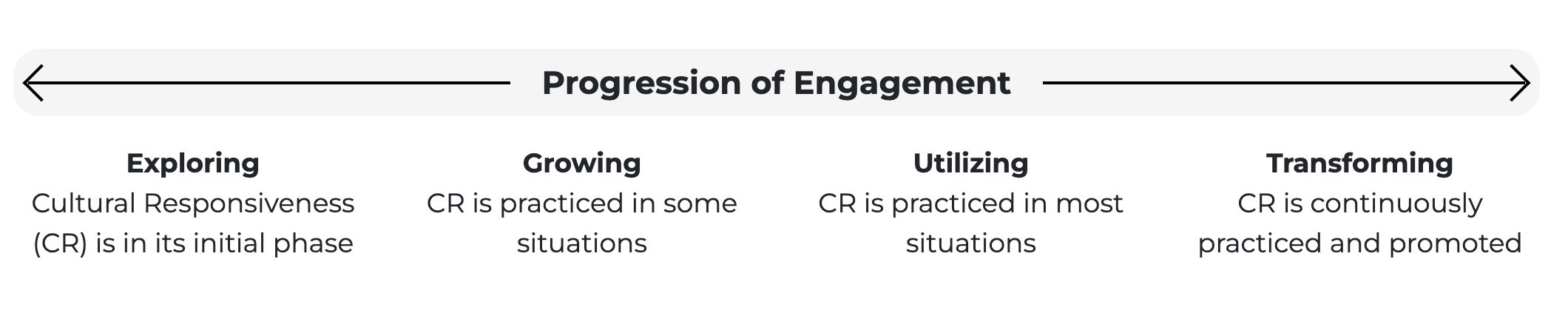

Questions for Discussion:
- Where do School 1 and School 2 belong on the Progression of Engagement? Why did you place them where you did?
- What are the benefits and downsides of School 2’s approach?
- What might need to be in place for school 2’s approach to work well?
- How do the descriptions of School 1 and School 2 compare with your school?
Activity 2: Connecting Curricula to Students’ Lives
Directions: Read the following descriptions of how two schools connect curricula to students’ lives. Then, indicate where you think they belong on the Progression of Engagement below and discuss the questions below with your group.
Classroom 1
In daily lessons, teachers modify the names, images, and scenarios in district-provided curricula to reflect the identities and experiences of the students and society. These changes help students identify themselves within the curriculum and increase engagement, while also introducing students to diverse identities and cultures.
Classroom 2
At the end of every lesson, teachers encourage students to make connections to their personal experiences and the world through exit tickets or discussion prompts. Rather than focusing solely on academic content, teachers ask, “How does this connect to you?” or “How does this connect to society?” These questions help students see relevance in what they’re learning and foster a stronger sense of engagement and motivation.
Questions for Discussion:
- Where do Classroom 1 and Classroom 2 belong on the Progression of Engagement? Why did you place them where you did?
- How do the descriptions of Classroom 1 and Classroom 2 compare with your class?
- Where would you place your classroom on the Progression of Engagement?
- In what ways can your class approach Transforming on this aspect of cultural responsiveness?
Activity 3: Pathways of Engagement
Directions: Consider the four elements of cultural responsiveness (Commitments, Empowerment, Relationships, Collaboration). Generate examples and/or descriptions of transformative cultural responsiveness for each element.
Commitments
School community member dedication to culturally responsive practices across the school experience
How do transformative culturally responsive commitments look/sound/feel?
Empowerment
School practices include all school community member voices
How does transformative culturally responsive empowerment look/sound/feel?
Relationships
The quality of connections amongst school community members
How do transformative culturally responsive relationships look/sound/feel?
Collaboration
The extent of cooperation amongst school community members
How does transformative culturally responsive collaboration look/sound/feel?
A Brief Overview of Cultural Responsiveness
Strengthening the connections amongst schools, students and families is a powerful way to increase engagement, spark learning, and improve outcomes. Culturally responsive schools work productively with children, families, and communities from a wide range of backgrounds by understanding cultural distinctiveness, recognizing and addressing potential biases, and creating a nurturing and inclusive school environment for all education partners. These schools empower youth, both intellectually and emotionally, and engage them in positive situations that affirm their cultural background and celebrate their capabilities. By increasing school efforts to better understand and reflect students’ backgrounds, family cultures and community connections, educators will be better equipped to support the distinct academic, social, and emotional needs of all their students.
Culturally responsive schooling encompasses many aspects of the schooling experience, including the school’s environment and culture, school leadership, teaching practices, and community relationships. Culturally responsive school leaders develop and support their school staff and promote a climate that makes the whole school welcoming, inclusive, and accepting of minoritized students and families. Culturally responsive curriculum and pedagogy emphasizes the cultural knowledge, past experiences, and learning styles of students of various ethnic groups to make learning more relevant to and effective for students. Culturally responsive teachers have affirming views of students from diverse backgrounds, understand how learners construct knowledge, and see themselves as capable and responsible for bringing about student academic, social, and emotional growth.
To learn more about cultural responsiveness, visit the resource repository in the CRS 360 Toolkit at www.crs360toolkit.org.